
A person in a green shirt stands with a joyful expression.

Results for Jaypirca from 2 clinical trials in CLL/SLL

Not an actual patient.

Understanding how Jaypirca was studied in CLL

Jaypirca was studied in 2 different clinical trials in people with CLL/SLL. In the more recent trial, Jaypirca was compared with 2 other possible treatments. The primary measure of this trial was how long people lived without their disease getting worse (progression-free survival). In the earlier trial, Jaypirca was studied alone. The primary measure of that trial was the percentage of people who responded to treatment with Jaypirca. (A response means their cancer shrank and stopped spreading.) This study also measured how long those responses lasted.

Clinical trial of Jaypirca against 2 other treatments

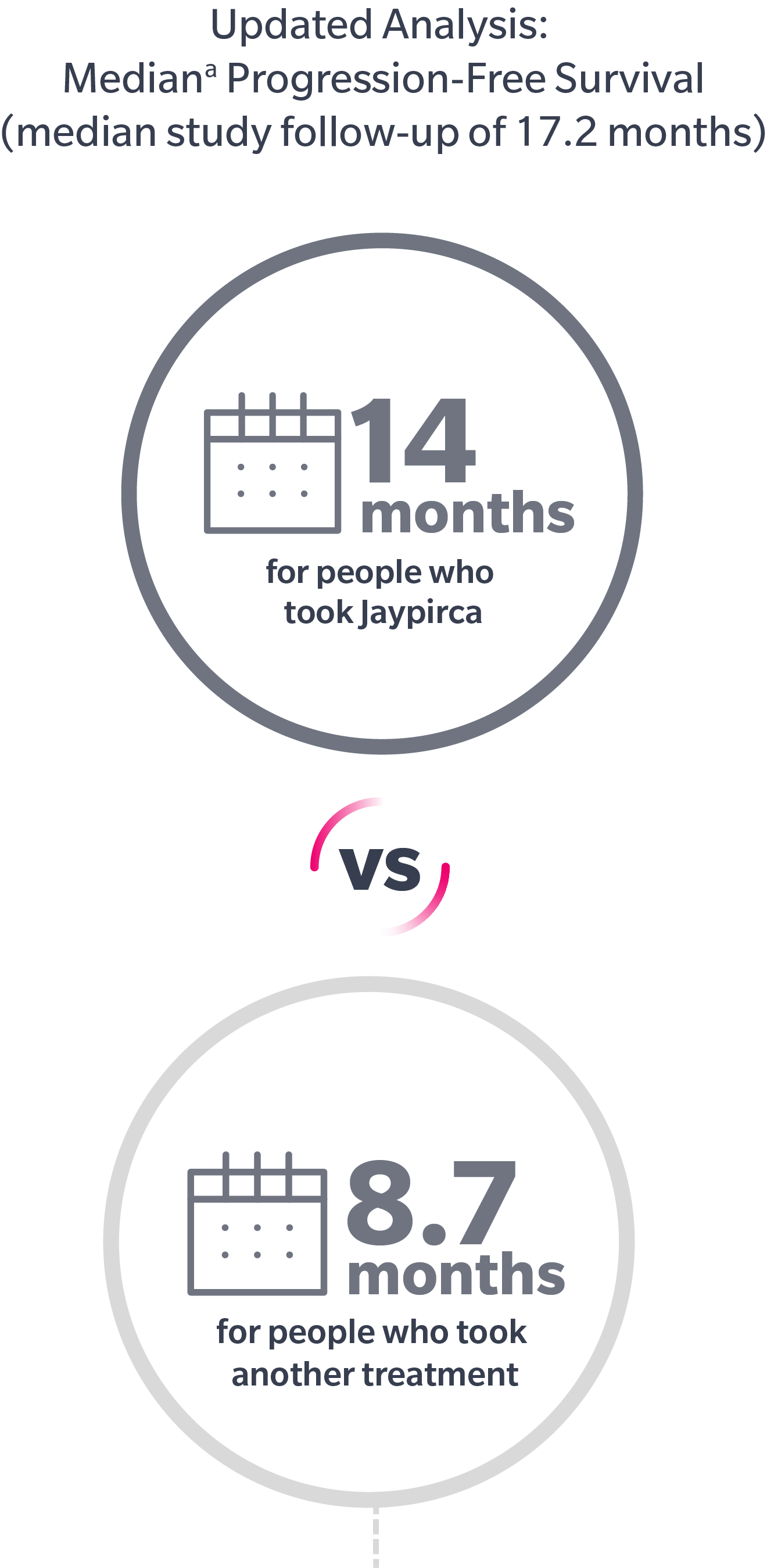
In the primary analysis, Jaypirca delayed CLL progression longer

The trial measured progression-free survival (how long patients lived without their CLL getting worse) in 119 people who were assigned to take Jaypirca and 119 people who were assigned to take another treatment.
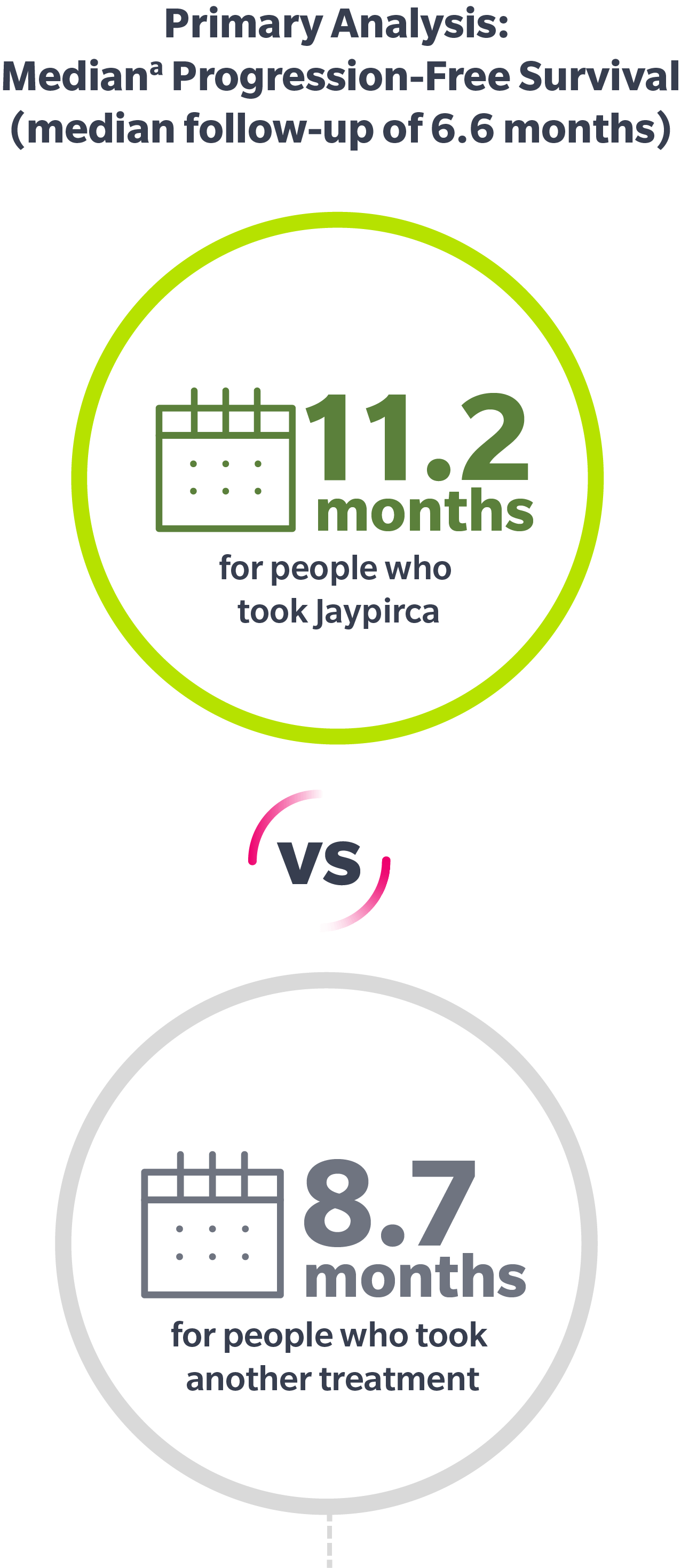
11 months

People in this group were assigned to take 1 of 2 treatment combinations. One was idelalisib plus rituximab, and the other was bendamustine plus rituximab. Either combination may be used to treat CLL.

14 months

People in this group were assigned to take 1 of 2 treatment combinations. One was idelalisib plus rituximab, and the other was bendamustine plus rituximab. Either combination may be used to treat CLL.

The data collected in the updated analysis of progression-free survival are from an unplanned look at the data that used less rigorous testing. This means the findings are less certain and may be due to chance.

aMedian is the middle number in a range of numbers.
Jaypirca was studied in 238 adults with relapsed or refractory* CLL

  • All people in the study had already received a Bruton’s tyrosine kinase (BTK) inhibitor
  • The trial measured how long people lived without their CLL getting worse (progression-free survival)
  • The people in the trial were randomly assigned to receive either Jaypirca (119 people) or 1 of 2 other CLL treatment combinations (119 people)
  • People who were assigned to receive Jaypirca took it until their CLL got worse or they were no longer able to tolerate treatment

*Refractory is when your cancer doesn't respond to treatment.

These combinations were idelalisib plus rituximab or bendamustine plus rituximab.

SELECT SAFETY INFORMATION

Warnings - Jaypirca may cause serious side effects, including:

Bleeding problems (hemorrhage). Bleeding problems can happen during treatment with Jaypirca. They can be serious and may lead to death. Your risk of severe bleeding may increase if you are also taking a blood thinner medicine. Tell your doctor if you have any signs or symptoms of bleeding, including:

  • blood in your stools or black stools (looks like tar)
  • pink or brown urine
  • unexpected bleeding, or bleeding that is severe or you cannot control
  • vomit blood or vomit blood that looks like coffee grinds
  • cough up blood or blood clots
  • increased bruising
  • dizziness
  • weakness
  • confusion
  • changes in your speech
  • headache that lasts a long time

Clinical trial of Jaypirca studied alone

In a clinical trial that measured the number of people who responded to treatment and how long the response lasted:

green ring of circles

72%

of adults with CLL (78 out of 108) saw their cancer shrink and stop spreading while taking Jaypirca

For those who saw their CLL shrink and stop spreading, their response lasted a median of 12.2 months.

Median is the middle number in a range of numbers.

Jaypirca was studied in a clinical trial that included adults with CLL who had received at least two treatments, including a Bruton’s tyrosine kinase (BTK) inhibitor and a B-cell lymphoma 2 (BCL-2) inhibitor.

Jaypirca was studied in 108 adults with previously treated CLL

caretDown Caret Down

All people in the study were treated with a prior BTK inhibitor and a BCL-2 inhibitor

caretDown Caret Down

Trial evaluated response to treatment and how long the response lasted (a response means their cancer shrank and stopped spreading)

caretDown Caret Down

Trial participants took Jaypirca once daily until their disease got worse or they were no longer able to tolerate treatment

black image with sparks

Taking Jaypirca and possible side effects

SAFETY SUMMARY

Warnings - Jaypirca may cause serious side effects, including:

Infections. Infections can happen during treatment with Jaypirca. These infections can be serious and may lead to death. Your doctor may prescribe vaccines and certain medicines if you have an increased risk of getting infections. Tell your doctor right away if you have fever, chills, weakness, flu-like symptoms, or any other signs of infection during treatment with Jaypirca.

Bleeding problems (hemorrhage). Bleeding problems can happen during treatment with Jaypirca. They can be serious and may lead to death. Your risk of severe bleeding may increase if you are also taking a blood thinner medicine. Tell your doctor if you have any signs or symptoms of bleeding, including:

  • blood in your stools or black stools (looks like tar)
  • pink or brown urine
  • unexpected bleeding, or bleeding that is severe or you cannot control
  • vomit blood or vomit blood that looks like coffee grinds
  • cough up blood or blood clots
  • increased bruising
  • dizziness
  • weakness
  • confusion
  • changes in your speech
  • headache that lasts a long time

Decrease in blood cell counts. Decrease in white blood cells, platelets, and red blood cells are common with Jaypirca, but can also be severe. This may increase your risk of infection, bleeding, and anemia. Your doctor should do blood tests regularly during treatment to monitor your counts.

Heart rhythm problems. Heart rhythm problems including atrial fibrillation and atrial flutter have happened in people treated with Jaypirca. Your risk for heart rhythm problems may be increased if you have high blood pressure or have had heart rhythm problems in the past. Tell your doctor if you have any of the following symptoms:

  • fast or irregular heartbeat (palpitations)
  • dizziness
  • fainting
  • chest discomfort
  • shortness of breath

Second primary cancers. New cancers have happened during treatment with Jaypirca, including cancers of the skin or other organs. Your doctor will check you for other cancers during treatment. Use sun protection when you are outside in sunlight.

Liver Problems. Liver problems, which may be severe or life-threatening, or lead to death, can happen in people treated with Jaypirca. Your doctor will do blood tests to check your liver before and during treatment with Jaypirca. Tell your doctor or get medical help right away if you have any signs of liver problems, including stomach pain or discomfort, dark-colored urine, or yellow skin and eyes.

Your doctor may decrease your dose, temporarily stop, or permanently stop treatment with Jaypirca if you develop severe side effects.

Common side effects

  • decreased white blood cell count
  • decreased red blood cell count
  • tiredness
  • decreased platelet count
  • decreased calcium

These are not all the possible side effects with Jaypirca. Call your doctor for medical advice about side effects. You may report side effects at 1-800-FDA-1088 or www.fda.gov/medwatch.

Before using

Before taking Jaypirca, tell your doctor about all your medical conditions, including if you:

  • have an infection or have been advised that you are at increased risk of infection
  • have had recent surgery or plan to have surgery. Your doctor may stop Jaypirca for a planned medical, surgical, or dental procedure
  • have bleeding problems and/or are taking blood thinner medicine
  • have or have had heart rhythm problems
  • have high blood pressure
  • have a history of other cancers, including skin cancer
  • have kidney problems
  • have liver problems
  • are pregnant or plan to become pregnant. Jaypirca can harm your unborn baby. If you are able to become pregnant, your doctor will do a pregnancy test before starting treatment
    • Females who are able to become pregnant should use effective birth control (contraception) during treatment and for at least 1 week after the last dose of Jaypirca. Tell your doctor right away if you become pregnant or think you are pregnant during treatment
  • are breastfeeding or plan to breastfeed. It is not known if Jaypirca passes into breast milk. Do not breastfeed during treatment and for at least 1 week after your final dose

Also tell your doctor about all the medicines you take, including prescription and over-the-counter medicines, vitamins, and herbal supplements. Taking Jaypirca with certain other medicines may affect how Jaypirca or the other medicines work and can cause side effects.

How to take

  • Take Jaypirca exactly as your doctor tells you
  • Do not change your dose or stop taking Jaypirca unless your healthcare provider tells you to do so
  • Take Jaypirca 1 time each day at about the same time each day
  • Take Jaypirca with or without food
  • Swallow Jaypirca whole with water. Do not cut, crush, or chew the tablets
  • If you miss a dose of Jaypirca, take it as soon as you remember on the same day. If you miss taking a dose by more than 12 hours from the time you usually take Jaypirca, skip the missed dose. Take the next dose on the next day at your usual time

Learn more

Jaypirca is a prescription medicine. For more information, call 1-800-545-5979 or go to www.jaypirca.lilly.com. This summary provides basic information about Jaypirca but does not include all information known about this medicine. Read the information that comes with your prescription each time your prescription is filled. This information does not take the place of talking with your doctor. Be sure to talk to your doctor or other healthcare provider about Jaypirca and how to take it. Your doctor is the best person to help you decide if Jaypirca is right for you.

PT CON BS COMBO DEC2025

Jaypirca® is a registered trademark owned or licensed by Eli Lilly and Company, its subsidiaries, or affiliates.

INDICATIONS

Jaypirca® (JAY-PIHR-KAA) is a prescription medicine used to treat adults with

  • mantle cell lymphoma (MCL) that has come back or did not respond to previous treatment and who have already received at least 2 treatments for their cancer, including a Bruton tyrosine kinase (BTK) inhibitor medicine.

    Jaypirca was approved for this indication based on how many people responded to treatment. Studies are ongoing to confirm the benefit of Jaypirca for this use.
  • chronic lymphocytic leukemia (CLL) or small lymphocytic lymphoma (SLL) that has come back or did not respond to previous treatment and who have already been treated with a BTK inhibitor for their cancer.

It is not known if Jaypirca is safe and effective in children.